

Malaysia's Budget 2027, tabled on 9 October 2026, does not change the National Sustainability Reporting Framework (NSRF) and does not introduce a carbon tax. Its sustainability measures extend green technology tax incentives to 2030, fund grid and renewable energy investment, support sustainable sukuk and expand flood resilience spending. Each feeds into IFRS S2 transition plans and climate disclosures.
Budget 2027 and sustainability: key facts
| Item | Detail |
|---|---|
| Tabled | 9 October 2026, by Prime Minister and Finance Minister Anwar Ibrahim |
| Size | RM510 billion in total, including RM459.8 billion of federal spending |
| Green tax incentives | Green Investment Tax Allowance (GITA) extended to 31 December 2030, at 60% or 100% depending on tier |
| Grid and renewables | TNB to invest RM15 billion in the national grid; RM1.5 billion solar park for government buildings |
| Climate finance | KWAP Climate Fund of RM1 billion; BPMB RM7 billion for seven strategic sectors, including renewable energy |
| Sustainable sukuk | Tax deduction on Sukuk Prisma issuance costs, years of assessment 2027 to 2030 |
| Climate adaptation | RM100 million for Klang Valley flood ponds and rivers; RM260 million for NADMA |
| Nature | Ecological Fiscal Transfer to states raised to RM270 million |
| Wages and governance | Minimum wage RM2,000 from June 2027; public disclosure of government contracts under the Government Procurement Act from 2027 |
| Carbon tax | Not included; put on hold in April 2026 |
| Sustainability reporting | No change to NSRF timelines or assurance requirements |
| Status | Proposals until Parliament passes the Supply Bill and Finance Bill |
Sources: Ministry of Finance, Budget 2027 speech and tax measures annex.
What sustainability measures are in Budget 2027?
Budget 2027 places the energy transition under its fifth pillar, on securing supply and national preparedness. Most sustainability measures are investments and incentives, not new rules. The table lists the measures most relevant to companies, as announced in the Budget 2027 speech.
| Area | Measure | Amount or period |
|---|---|---|
| Grid | TNB investment to strengthen the national grid | RM15 billion |
| Renewables and storage | UEM Lestra energy storage at KLIA and a 1 GW hybrid energy project in Johor | RM1 billion |
| Government solar | Centralised solar park for government buildings | RM1.5 billion |
| Large-scale solar | LSS6 capacity set aside for Bumiputera companies | 150 MW |
| Climate finance | KWAP Climate Fund for renewable energy and decarbonisation projects | RM1 billion |
| Development finance | BPMB financing for seven strategic sectors, including renewable energy | RM7 billion |
| Energy efficiency | NUR MADANI rebate on energy-efficient air conditioners and refrigerators | Up to RM200 |
| Green tax incentives | Green Investment Tax Allowance for green projects and own-use assets | To 31 December 2030 |
| EV charging | Charging facilities at strategic highway locations | 50 facilities |
| Water | National non-revenue water programme replacing 1,900 km of old pipes | RM2.5 billion |
| Nature | Ecological Fiscal Transfer to states for conservation | RM270 million |
| Nature | Palm oil cess for habitat protection of the Malayan tiger, Borneo elephant and orangutan | RM15 million |
| Biodiversity | 2,500 community rangers from Orang Asli, army veterans and police retirees, including ranger posts | RM65 million |
| Marine | Buy-back scheme for old fishing nets; sewerage upgrades on Tuba, Langkawi, Redang and Tioman | Not stated |
| Urban green space | DBKL to create 120 acres of new green space, restore parks and upgrade facilities and public housing | RM400 million |
| Urban green space | Leased land in Bukit Kiara gazetted as a federal park | 100 acres |
The speech also notes the Pengerang Biorefinery, which will produce sustainable aviation fuel, HVO and bio-naphtha, and TNB and PETRONAS involvement in the ASEAN Power Grid.
What changed in Malaysia's green technology tax incentives?
The Green Investment Tax Allowance (GITA) continues to 31 December 2030, but its qualifying list has been reshaped. Under the tax measures annex, it covers MIDA project applications and MGTC-certified asset purchases from 1 January 2027. The speech said "up to 100%"; the annex sets 100% or 60% by tier.
GITA has two parts. GITA projects are for companies running green technology projects as a business, through MIDA. GITA assets are for companies buying green technology assets for their own use, certified by MGTC.
GITA projects (business purposes)
| Tier | Qualifying activities | Allowance |
|---|---|---|
| Tier 1 | Green hydrogen; ocean thermal energy conversion | 100% of qualifying capital expenditure, set against 100% or 70% of statutory income, 5 + 5 years |
| Tier 2 | EV charging stations; biomass, biogas, mini hydro, geothermal and wind | 60%, set against 70% of statutory income, 5 years |
GITA assets (own use): what decides Tier 1 or Tier 2?
For own-use assets, two things decide the tier: whether certain systems are locally made, and whether renewable energy comes with energy storage. Both tiers are set against 70% of statutory income. The difference is the allowance rate: 100% for Tier 1 and 60% for Tier 2.
| Asset | Tier 1 (100% allowance) |
|---|---|
| Electric commercial vehicles | Buses, vans, panel MPVs, movers, terminal tractors, forklifts, light trucks, lorries and heavy vehicles, including prime movers; no local-made condition |
| EV charging infrastructure | Locally made products |
| Waste composting and recycling systems | Locally made products |
| Wastewater recycling and rainwater harvesting systems | Locally made products |
| Biomass, biogas, mini hydro, geothermal and wind | Integrated with battery or energy storage |
| Solar | Integrated with battery or energy storage |
The annex labels the Tier 1 systems "produk tempatan" (local products) and leaves that label off in Tier 2. How a product is shown to be locally made should be set out in MGTC guidelines.
In practice, the tier works out like this:
- Electric lorries or prime movers: 100%, whether the vehicle is imported or locally assembled.
- Wastewater recycling system: 100% if locally made; 60% for the same system from an overseas supplier.
- Rooftop solar: no allowance on its own; 100% when installed with a battery energy storage system.
- Biomass or biogas system: 60% on its own; 100% when integrated with energy storage.
The rate matters. On a RM1 million asset, the allowance is RM1 million in Tier 1 and RM600,000 in Tier 2. At the 24% corporate tax rate, that is a tax saving of up to RM240,000 against RM144,000, if the company has enough statutory income.
Tax saving = qualifying capital expenditure × allowance rate × corporate tax rate
The allowance can be used against up to 70% of statutory income each year. Companies must apply to MGTC within 24 months of buying a qualifying asset, so suppliers should be asked early for evidence of local manufacture.
Three changes stand out against the 2024 to 2026 incentives:
- Standalone solar is no longer listed. Solar qualifies only as an own-use asset integrated with battery or energy storage.
- Integrated waste management no longer appears as a GITA project, and EV charging projects move from 100% to 60%.
- The Green Income Tax Exemption for solar leasing does not appear in the revised incentives.
These measures are proposals until the Finance Bill is passed and guidelines are issued. Companies should confirm eligibility with MIDA, MGTC or their tax adviser.
How can Budget 2027 relate to NSRF reporting?
Budget 2027 does not change the NSRF timeline. However, some items in Budget 2027 can be the input to several IFRS S2 disclosures. The diagram maps each group of measures to the disclosure area it affects.
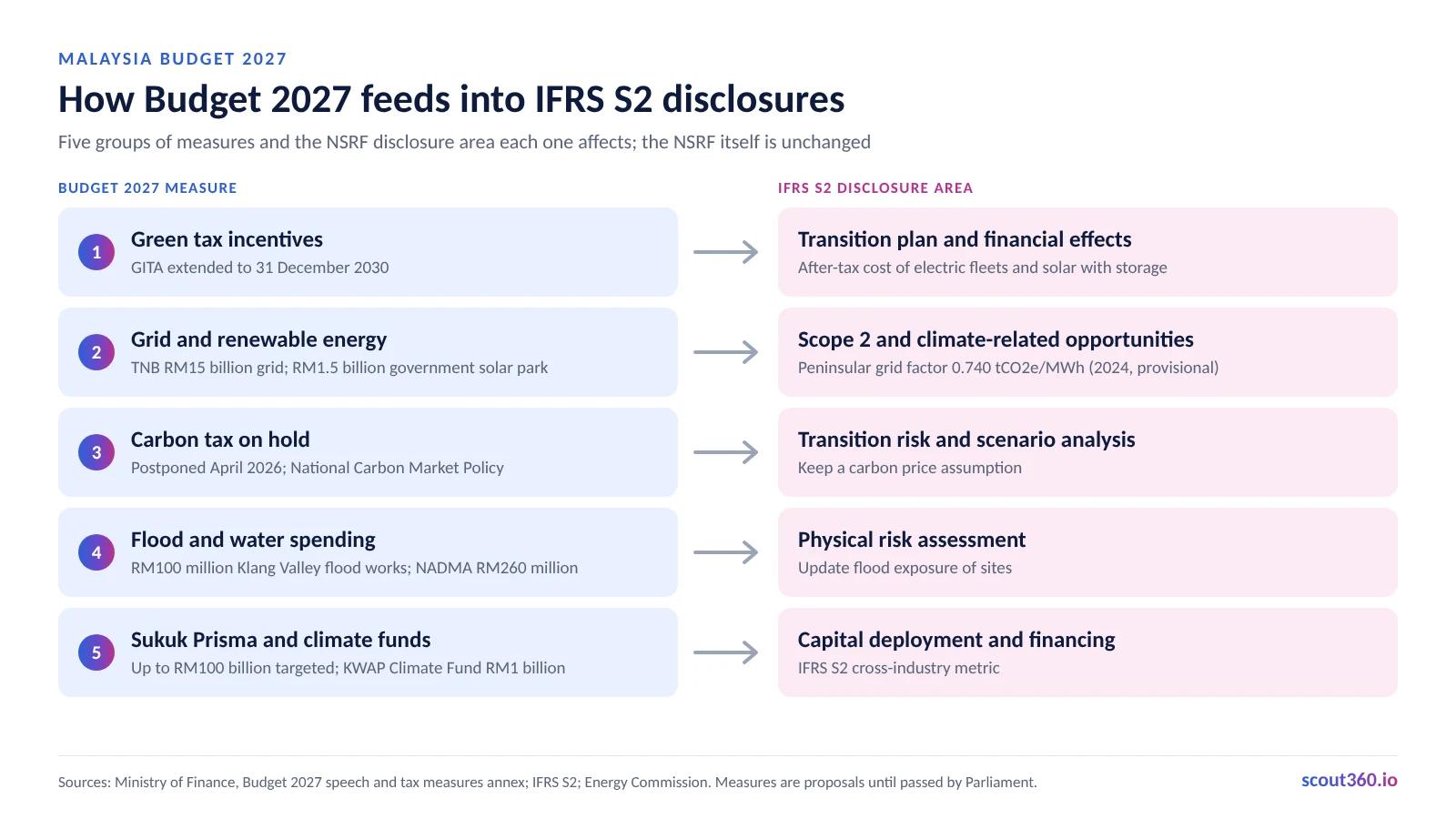
- Green tax incentives and the transition plan. IFRS S2 asks how a company will resource its transition plan. GITA lowers the after-tax cost of electric fleets and solar with storage, which affects anticipated financial effects.
- Grid and renewable energy investment, Scope 2 and opportunities. New grid capacity and renewables should lower grid emissions over time. The current Peninsular grid factor is 0.740 tCO2e/MWh (Energy Commission, 2024 provisional).
- Carbon tax on hold and transition risk. A postponed carbon tax is still a transition risk. Scenario analysis should keep a carbon price assumption.
- Flood and water spending and physical risk. Public flood mitigation shows where acute physical risk is highest. It reduces exposure but does not remove it.
- Sukuk Prisma, climate funds and capital deployment. IFRS S2 cross-industry metrics include capital deployed towards climate-related risks and opportunities. Proceeds raised through Sukuk Prisma, or funding from sources such as the KWAP Climate Fund, count once they are spent on qualifying projects. They also show how the transition plan is financed.
Is there a carbon tax in Budget 2027?
No. Budget 2027 contains no carbon tax measure. Budget 2026 had announced a carbon tax from 2026, starting with the iron, steel and energy sectors (Bernama).
In April 2026, Natural Resources and Environmental Sustainability Minister Arthur Joseph Kurup said the carbon tax was on hold because of the Middle East conflict. The government would first build a carbon credit framework and registry. The National Carbon Market Policy, approved by Cabinet on 1 April 2026, was launched at the same time (The Star).
For NSRF reporters, carbon pricing remains a reasonable transition risk to model. The Minister also said a Climate Change Bill is being finalised. Exporters of goods covered by the EU Carbon Border Adjustment Mechanism (CBAM) face a carbon cost regardless of Malaysian policy.
How does Budget 2027 support sustainable finance?
Budget 2027 supports Sukuk Prisma, a new sustainability sukuk the Securities Commission will introduce from 2027. According to the tax measures annex, the SC aims to attract up to RM100 billion over five years. Target areas are climate adaptation, water and food security, biodiversity resilience and the blue economy.
Sukuk Prisma issuers can deduct approved issuance costs for years of assessment 2027 to 2030. The existing deduction for SRI sukuk issuance costs continues to year of assessment 2027. Grants under the SRI Sukuk and Bond Grant Scheme become tax-exempt from 1 January 2027.
Sustainable sukuk issuers must report how proceeds are used and what they achieve. The emissions, energy and climate risk data behind IFRS S2 disclosures can support that reporting.
What climate adaptation measures are in Budget 2027?
Budget 2027 funds flood mitigation and disaster response across several states. RM100 million goes to retention ponds and river maintenance in the Klang Valley. The federal and Selangor governments will also assess the Batu and Klang Gates dams for the next 30 years.
New flood mitigation projects for 2027 include Kuching, Sungai Golok phase 2 in Kelantan and Sungai Kemaman in Terengganu. Planning will start on the Lebir Dam in Kelantan for flood control and water supply.
Nearly RM320 million is set aside for slopes and drains in local authority areas. NADMA receives RM260 million, and repair aid for disaster-hit homes doubles to RM10,000. Companies with sites in these areas should reflect the work in their physical risk assessment.
What does Budget 2027 mean for the social and governance parts of an ESG report?
Budget 2027 also changes several social and governance facts that companies report on. The minimum wage rises from RM1,700 to RM2,000 a month from June 2027. MSMEs with annual sales below RM50 million are exempted while they adjust.
The government will also introduce a minimum monthly salary of RM2,500 for semi-skilled jobs and graduates, as a first step; no start date was given. GLICs and GLCs will raise their living wage benchmark from RM3,100 to RM3,400 a month, covering 230,000 workers.
On governance, a bill will be drafted to tighten oversight of government companies and statutory bodies. Once the Government Procurement Act takes effect in 2027, government project information, including contractors and contract values, will be disclosed.
For sustainability reporting, these changes matter in four ways:
- Wage disclosures. Companies reporting on fair pay or living wages should check pay against the new floors, including for contract workers.
- Supply chains. Customers with living wage commitments, including GLCs, may ask suppliers for wage data, as they already do for emissions data.
- Financial planning. For labour-intensive companies, the higher wage floor is a cost that may be a material sustainability-related risk.
- NSRF scope. Transition relief allows climate-only reporting at first. After it ends, IFRS S1 requires disclosure of all material sustainability-related risks and opportunities, which can include workforce issues.
Budget 2027 also proposes tax deductions for companies taking part in the Bakat MADANI training programme from 29 June 2026 to 31 December 2030. Companies can report this under workforce development.
What should companies do with Budget 2027 in their ESG report or NSRF disclosures?
Companies preparing NSRF reports can use Budget 2027 in five practical ways:
Review decarbonisation projects for GITA. Check electric commercial vehicles and solar with battery storage first, and show the expected allowance in the transition plan.
Update opportunities and capital deployment. Add any grid, renewable energy or green financing commitments to these IFRS S2 metrics.
Keep carbon pricing in scenario analysis. Note the postponement and the National Carbon Market Policy, but keep a price assumption.
Refresh flood exposure. Re-assess sites in the Klang Valley, Kuching, Kelantan and Terengganu against new flood mitigation plans.
Keep one set of evidence. MGTC certificates, invoices and meter data support both incentive claims and Scope 1 and 2 assurance readiness.
SMEs also gain from lower SME tax rates from year of assessment 2027: 14% on the first RM150,000 and 16% up to RM600,000. Their customers' requests for emissions data continue regardless of the Budget.
Frequently asked questions
Does Malaysia's Budget 2027 change the NSRF? No. The NSRF reporting groups, transition relief and the 2028 to 2030 assurance timeline are unchanged.
Is there a carbon tax in Malaysia in 2027? Budget 2027 does not include one. The carbon tax announced in Budget 2026 was put on hold in April 2026, while the government builds a carbon credit framework.
How long is the Green Investment Tax Allowance available? GITA covers MIDA project applications and MGTC-certified asset purchases from 1 January 2027 to 31 December 2030.
Does solar still qualify for GITA under Budget 2027? Only as an own-use asset integrated with battery or energy storage. Standalone solar is no longer listed for GITA projects or assets.
What is Sukuk Prisma? Sukuk Prisma is a sustainability sukuk the Securities Commission will introduce from 2027, aiming to attract up to RM100 billion over five years. Approved issuance costs are tax-deductible for years of assessment 2027 to 2030.
How should Budget 2027 appear in an IFRS S2 disclosure? Mainly in the transition plan and its resourcing, climate-related opportunities, capital deployment, scenario analysis and physical risk assessment.
Will TNB's grid investment reduce my Scope 2 emissions? Not immediately. Location-based Scope 2 uses the published grid emission factor, which changes only as the grid mix improves; on-site solar reduces purchased electricity directly.
Does Budget 2027 help SMEs with ESG? Indirectly. SMEs gain lower tax rates and can claim GITA on assets such as electric lorries and recycling systems, but no dedicated SME ESG grant was announced.
What climate adaptation spending is in Budget 2027? RM100 million for Klang Valley flood ponds and rivers, new flood mitigation projects, nearly RM320 million for slopes and drains, and RM260 million for NADMA.
Does Budget 2027 affect the social part of an ESG report? Yes. The minimum wage rises to RM2,000 a month from June 2027, a RM2,500 minimum is planned for semi-skilled jobs and graduates, and GLICs and GLCs raise their living wage benchmark to RM3,400.
Are the Budget 2027 measures final? No. They remain proposals until Parliament passes the Supply Bill and Finance Bill, and some need guidelines from MIDA or MGTC.
How Scout360 can help
Scout360 helps companies to relate latest market developments and policies into NSRF-ready transition plans and climate disclosures, in three ways depending on how much support they need.
| Support | Suited to | What it covers |
|---|---|---|
| Full implementation support | Companies that want end-to-end support | IFRS S1 and S2 advisory, transition plan and decarbonisation roadmap development, disclosure preparation |
| Targeted technical support | Companies with an existing internal team or reporting partner | Gap assessment, climate risk and scenario analysis including carbon pricing and flood exposure, GHG accounting (Scope 1, 2 and 3), assurance readiness |
| Capacity building | Companies building internal sustainability capability | Training, implementation guidance, technical review |
Scout360 also offers a digital platform that simplifies data collection, calculation, review, evidence management and assurance preparation.
Sources
- Ministry of Finance, Budget 2027 speech (Ucapan Belanjawan 2027), 9 October 2026
- Ministry of Finance, Budget 2027 tax measures annex (Langkah Cukai Belanjawan 2027)
- The Edge Malaysia, Highlights of Budget 2027, 9 October 2026
- The Star (via Asia News Network), Malaysia's carbon tax on hold amid Mideast conflict, 22 April 2026
- Bernama, Budget 2026: carbon tax to be introduced next year, 10 October 2025
- Securities Commission Malaysia, National Sustainability Reporting Framework