

Carbon and GHG Reporting
Scope 1, Scope 2 and Scope 3 GHG reporting for Malaysian organisations.
Build a reliable greenhouse gas inventory using recognised methodologies, documented calculations and supporting evidence.
Scout360 helps organisations establish reporting boundaries, identify emission sources, calculate corporate GHG emissions and prepare carbon information for sustainability reporting, IFRS S2, customer requests and independent verification.
- Scope 1: directFuel combustion in boilers, furnaces and company vehicles, process emissions and refrigerant leakage.
- Scope 2: purchased energyPurchased or acquired electricity, steam, heating and cooling consumed by the organisation.
- Scope 3: value chainFifteen upstream and downstream categories, from purchased goods to use of sold products.
Scope 3 is frequently the largest and most challenging part of a footprint, because the information depends on suppliers, customers, estimates and external datasets.
The measurement basis
What are Scope 1, Scope 2 and Scope 3 emissions?
A greenhouse gas inventory measures emissions associated with an organisation's operations and value chain. The GHG Protocol classifies those emissions into three scopes.
Scope 1 covers direct emissions from sources owned or controlled by the organisation. Examples include fuel combustion in boilers, furnaces and company vehicles, process emissions and refrigerant leakage.
Scope 2 covers indirect emissions associated with purchased or acquired electricity, steam, heating and cooling consumed by the organisation. Depending on the reporting requirement and available contractual information, Scope 2 may involve location-based and market-based reporting.
Scope 3 covers other indirect emissions occurring upstream or downstream in the value chain. The GHG Protocol identifies 15 Scope 3 categories covering areas such as purchased goods and services, capital goods, transportation, waste, business travel, employee commuting, use of sold products, end-of-life treatment, franchises and investments.
How GHG Protocol and ISO 14064 work together
- GHG Protocol: the measurement basis
- IFRS S2 requires Scope 1, Scope 2 and Scope 3 emissions to be measured using the GHG Protocol Corporate Standard, except where an applicable jurisdictional authority or exchange requires a different method. IFRS S2 also requires organisations to consider all 15 Scope 3 categories and disclose which are included in the measurement.
- ISO 14064-1: inventory quality
- ISO 14064-1 specifies organisation-level principles and requirements for quantifying and reporting GHG emissions and removals. It can strengthen inventory design, documentation and controls.
- ISO 14064-3: verification
- ISO 14064-3 specifies requirements for verifying and validating GHG statements. Bursa Malaysia recognises ISO as one of three assurance-standard pathways for Sustainability Statements, alongside ISSA 5000 and ISAE 3000.
The roles are complementary: the GHG Protocol provides the measurement basis referenced by IFRS S2, while ISO 14064 can strengthen inventory quality and support assurance. Using ISO 14064 does not remove the need to meet the GHG Protocol requirements applicable to the disclosure.
In September 2025, ISO and GHG Protocol announced a strategic partnership to harmonise their existing portfolios and co-develop new GHG accounting and reporting standards. That work is ongoing; organisations should continue applying the current standards relevant to their reporting period.
Applicability
When will GHG reporting requirements apply?
Under Malaysia's NSRF pathway, IFRS S2 adoption and related GHG disclosures are being phased by organisation group.
- 1
Group 1
Main Market issuers with market capitalisation of RM2 billion and above.
- IFRS S2 reporting begins
- 2025
- Scope 3 after transition relief
- 2027
- 2
Group 2
Other Main Market issuers.
- IFRS S2 reporting begins
- 2026
- Scope 3 after transition relief
- 2028
- 3
Group 3
ACE Market issuers and large non-listed companies within the NSRF threshold.
- IFRS S2 reporting begins
- 2027
- Scope 3 after transition relief
- 2030
Scope 3 dates reflect the end of the stated transition-relief period. The actual requirement depends on the organisation's reporting period and applicable regulatory provisions.
Assurance over Scope 1 and Scope 2: intended, not yet final
Malaysia intends to phase in reasonable assurance over Scope 1 and Scope 2 emissions, beginning with Group 1 for reporting periods starting in 2027, followed by Group 2 in 2028 and Group 3 in 2029. The detailed assurance framework and timing remain subject to the relevant regulatory process.
Proposed extension to non-listed companies: a consultation, not a requirement
Separately, SSM's 2026 public consultation proposed extending sustainability reporting to a wider group of non-listed companies under the Companies Act 2016. The proposed pathway begins in 2028 for companies with RM1 billion to RM2 billion in annual revenue or at least 500 employees. Companies with RM15 million to RM100 million in revenue, or 100 to 249 employees, are proposed to begin in 2032.
These are consultation proposals, not final legal requirements, and may change before implementation.
Scope 3 boundaries, supplier data and estimation methods often require more than one reporting cycle to stabilise.
Why it matters
Why accurate GHG data is becoming a compliance issue.
Prepare for Malaysia's carbon tax
Budget 2026 provides for a Carbon Tax Act and implementation mechanisms, initially focused on iron, steel and energy. A reliable inventory helps organisations assess exposure once coverage, rates and commencement are finalised.
Meet NSRF and Bursa reporting requirements
The NSRF phases in IFRS S2 disclosures covering Scope 1, Scope 2 and, later, Scope 3. Reporting entities need defensible boundaries, methods and records, not only a headline footprint.
Support GHG assurance
As assurance requirements develop, traceable data, emission factors, workpapers and evidence will be needed to support reported GHG statements and verifier queries.
Malaysia's carbon tax is still being formulated. Coverage, rates and commencement are not settled until the Carbon Tax Act and its implementing instruments are finalised.
Scope of support
What Scout360 can support.
Reporting boundaries and inventory design
Define the organisational and operational boundaries, select an appropriate consolidation approach, establish the reporting period and base year, and document relevant exclusions or limitations.
Emission-source and Scope 3 screening
Map Scope 1 and Scope 2 sources, assess all 15 Scope 3 categories, identify applicable upstream and downstream activities, and prioritise data collection according to relevance and materiality.
Data collection and calculation
Develop data templates, review source information, select appropriate emission factors, calculate emissions and document assumptions, estimates and data limitations.
GHG inventory and disclosure preparation
Prepare Scope 1, Scope 2 and Scope 3 results, methodology notes, category explanations, intensity measures and reporting information for sustainability disclosures or other agreed reporting needs.
Controls and verification readiness
Organise evidence, maintain calculation workpapers, introduce review checks, document changes from prior periods and address information gaps before independent verification or assurance.
Annual outsourced Scope 3 calculations
For organisations managing Scope 1, Scope 2 and wider reporting internally, Scout360 can calculate applicable Scope 3 categories annually and return a structured file documenting results, methods, emission factors, assumptions and exclusions.
Science-based targets and decarbonisation planning
Support emissions baselining, target modelling and preparation for science-based targets aligned with the applicable SBTi criteria. Where deeper sector, engineering or research capability is needed, Scout360 can work with specialist consultants and university collaborators to develop practical decarbonisation pathways. Target validation remains the responsibility of SBTi Services.
How the work runs
A practical GHG inventory framework.
1
Define purpose and boundaries
Confirm why the inventory is needed, which entities and operations are included, and which reporting criteria apply.
OutcomeA documented inventory boundary and reporting basis.
2
Map emission sources
Identify Scope 1 and Scope 2 sources, screen all Scope 3 categories and assign responsible data owners.
OutcomeA complete source map and prioritised data plan.
3
Collect and validate activity data
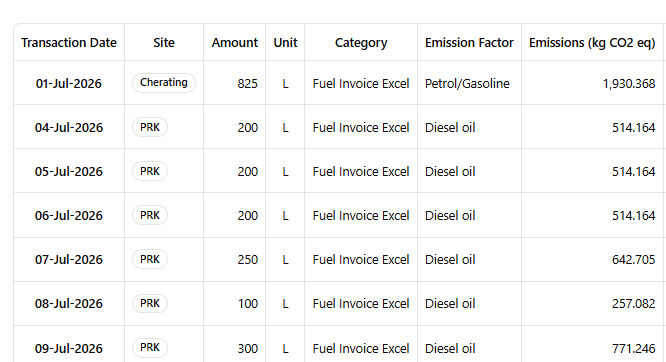
Gather invoices, meter readings, fuel records, travel data, procurement information and other relevant source evidence.
OutcomeMore complete and traceable calculation inputs.
4
Calculate and document emissions
Apply appropriate methodologies, emission factors and assumptions, then record calculation choices and data limitations.
OutcomeReproducible Scope 1, Scope 2 and Scope 3 calculations.
5
Review and consolidate the inventory
Perform quality checks, investigate unusual results, avoid duplication and consolidate information across entities and sites.
OutcomeA more reliable group-level carbon footprint.
6
Report, verify and improve
Prepare the inventory report and disclosures, support review or verification, and strengthen weak data sources during the next cycle.
OutcomeA recurring inventory that becomes more robust over time.
Platform-supported reporting
Manage recurring carbon reporting through Scout360.
The Scout360 Platform supports Scope 1, Scope 2 and all 15 Scope 3 categories while retaining source information, calculation records and evidence across entities, sites and reporting periods.
Organisations may use the broader platform, engage Scout360 for annual calculations, or combine internal data collection with recurring specialist support.
Where this connects
Related services.
Common questions
Frequently asked questions.
The appropriate criteria depend on the reporting purpose. IFRS S2 references the GHG Protocol Corporate Standard. ISO 14064-1 can strengthen inventory design and reporting, while ISO 14064-3 addresses verification and validation of GHG statements.
Organisations should screen all 15 categories and determine which are applicable and relevant. IFRS S2 requires disclosure of which categories are included in the Scope 3 measurement.
Yes. Scope 3 frequently uses estimates and secondary data where primary information is unavailable. The methods, sources, assumptions and limitations should be documented transparently and improved over time.
Yes. An annual outsourced Scope 3 calculation service is available for organisations that manage Scope 1, Scope 2 and wider sustainability reporting internally.
Build a carbon inventory you can explain, repeat and improve.
Whether you are starting with Scope 1 and Scope 2 or building a complete value-chain inventory, Scout360 can tailor the work around your reporting purpose, available data and internal capability.
We aim to respond within two business days.
Technical and regulatory information last reviewed: 7 August 2026.
Official references: IFRS Foundation: GHG requirements in IFRS S2, GHG Protocol Corporate Standard, ISO 14064-1, ISO 14064-3, Bursa Malaysia: recognised assurance standards, Malaysia Budget 2026: carbon tax, SSM: 2026 sustainability reporting consultation, SBTi standards and guidance, and Securities Commission Malaysia: NSRF.