

Bursa Malaysia Sustainability Reporting
Bursa Malaysia sustainability reporting support for listed companies.
Prepare a clearer, better-controlled Sustainability Statement supported by defined responsibilities, consistent data and appropriate evidence.
Scout360 helps Main Market and ACE Market listed companies understand their applicable Bursa Malaysia sustainability reporting requirements, organise the reporting process and prepare disclosures that reflect their actual operations.
For listed companies preparing their first Sustainability Statement, strengthening an existing report or transitioning towards IFRS S1 and IFRS S2.
- 1RequirementsWhich Listing Requirements apply to this reporting period.
- 2Data ownersNamed responsibility for every disclosure and figure.
- 3EvidenceSource records behind the numbers, kept as they are collected.
- 4ReviewTechnical, management and board review before approval.
- 5Sustainability StatementA disclosure grounded in the organisation's operations.
The statement is the visible output. What makes it defensible is everything above it.
The requirement
What is Bursa Malaysia sustainability reporting?
Companies listed on Bursa Malaysia's Main Market and ACE Market are required to include a Sustainability Statement in their annual reporting. The statement explains how the organisation identifies, manages and reports relevant sustainability matters, performance information and related governance processes.
A Sustainability Statement may be included in the annual report or issued as a standalone statement, provided the applicable Listing Requirements are met and the standalone statement is issued concurrently with the annual report.
The reporting framework is now transitioning towards Malaysia's National Sustainability Reporting Framework, which uses IFRS S1 and IFRS S2 as the baseline disclosure standards. This means the requirements that apply to a listed company depend on its market, issuer group and reporting period.
For organisations entering the IFRS Sustainability Disclosure Standards phase, the Sustainability Statement increasingly focuses on material sustainability-related risks and opportunities that could affect the organisation's prospects. It must be supported by governance, strategy, risk-management, metrics and targets processes.
The statement is therefore more than a year-end writing exercise. It depends on coordinated work across finance, sustainability, risk, human resources, procurement, operations and the board.
Applicability
Which reporting requirements apply, and when?
Bursa Malaysia has aligned the phased introduction of the IFRS Sustainability Disclosure Standards with Malaysia's NSRF pathway.
- 1
Group 1
Main Market listed issuers with market capitalisation of RM2 billion and above.
- IFRS-aligned statement begins
- Financial years ending on or after 31 December 2025
- 2
Group 2
Other Main Market listed issuers.
- IFRS-aligned statement begins
- Financial years ending on or after 31 December 2026
- 3
Group 3
ACE Market listed corporations.
- IFRS-aligned statement begins
- Annual reporting periods beginning on or after 1 January 2027
For a calendar-year ACE Market issuer, the Group 3 requirement would first apply to the reporting period ending 31 December 2027, with the corresponding annual report generally issued in 2028.
Requirements and transitional arrangements may change. Listed companies should confirm the applicable Listing Requirements for each reporting period.
Transition from the earlier Bursa framework
The third edition of Bursa Malaysia's Sustainability Reporting Guide and related toolkits remained applicable during specified transition periods:
- Group 1 could refer to them through financial year ended 31 December 2024.
- Group 2 could refer to them through financial year ended 31 December 2025.
- ACE Market issuers may refer to them through financial year ended 31 December 2026.
For ACE Market Sustainability Statements issued for financial years ending on or after 31 December 2025, the common sustainability matters introduced under the earlier enhanced framework are no longer mandatory. Companies must nevertheless continue preparing a Sustainability Statement according to the requirements applicable to their reporting period.
Transition reliefs under the NSRF may allow eligible issuers to begin with climate-related disclosures before moving to the complete IFRS S1 and IFRS S2 requirements. The appropriate reporting approach should be confirmed against the issuer's group and financial year.
Why it matters
Why listed issuers need a controlled reporting process.
Reported information must withstand review
Boards and management need a clear basis for approving the statement. Defined boundaries, calculation methods, data ownership, supporting evidence and review controls help the company respond to internal review, independent assurance and regulatory questions.
Who this service is for
Scout360's Bursa Malaysia sustainability reporting support is designed for:
- newly listed or first-time reporting companies;
- Main Market and ACE Market issuers reviewing which requirements apply;
- organisations with fragmented data collection and unclear ownership;
- reporting teams transitioning towards IFRS S1 and IFRS S2; and
- companies seeking external support while retaining internal control of their reporting process.
Scope of support
What Scout360 can support.
The engagement can cover the complete reporting cycle or selected workstreams according to the organisation's internal capability.
Requirements and reporting roadmap
Confirm the applicable Bursa Malaysia requirements, reporting period and transition pathway; review the previous Sustainability Statement; identify gaps; and establish a practical reporting plan.
Reporting scope and material matters
Define the reporting boundary and relevant entities, sites and operations; review the organisation's material sustainability matters; and align the assessment approach with the requirements applicable to that reporting period.
Governance and data ownership
Clarify board and management oversight, assign responsible data owners, develop reporting instructions and establish timelines for submission, review and approval.
ESG data, GHG emissions and evidence
Develop data-collection templates, calculate or review relevant indicators and Scope 1, Scope 2 and Scope 3 emissions, document methodologies, and organise supporting evidence.
Sustainability Statement preparation
Develop the report structure, coordinate content from responsible teams, draft or review disclosures, improve consistency between narrative and performance data, and support management and board review.
Reporting controls and internal capability
Introduce validation checks, maintain calculation and evidence records, document reporting limitations, and train responsible teams so the process can be repeated more effectively in the next cycle.
What this support looks like for a listed issuer.
How the work runs
A practical Sustainability Statement framework.
1
Confirm the applicable requirements
Determine the issuer group, reporting period, transition provisions, publication format and internal approval timetable.
OutcomeClarity on what must be reported and when.
2
Review the current reporting position
Assess the previous statement, governance arrangements, material matters, available data and unresolved information gaps.
OutcomeA prioritised reporting plan rather than a generic checklist.
3
Define boundaries and responsibilities
Confirm the entities, sites and operations included, assign data owners and establish submission, review and evidence requirements.
OutcomeClear accountability across the reporting organisation.
4
Collect and validate information
Gather qualitative and quantitative information, apply documented methodologies, investigate unusual movements and retain supporting evidence.
OutcomeMore consistent and traceable reporting information.
5
Prepare and review the statement
Develop the narrative, performance tables and relevant disclosures, then coordinate technical, management and board review.
OutcomeA clearer Sustainability Statement grounded in the organisation's operations.
6
Improve the next reporting cycle
Record limitations, lessons and improvement actions, then strengthen weak data sources, controls and internal capability before the following year.
OutcomeA reporting process that becomes more efficient and reliable over time.
Platform-supported reporting
Manage recurring reporting through Scout360.
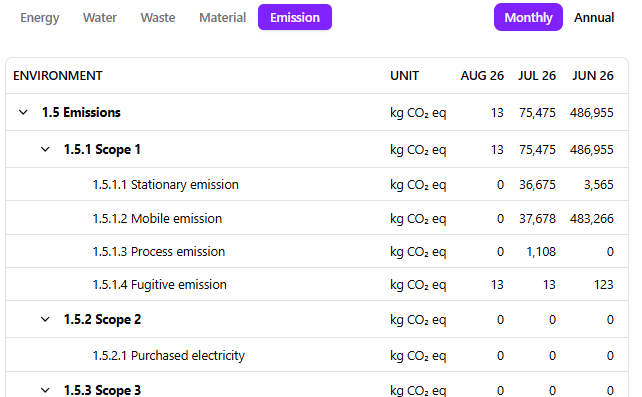
The Scout360 Platform can support the annual reporting process by centralising sustainability data, GHG calculations, supporting evidence and information across entities or sites.
- Assign reporting information to responsible data owners.
- Manage Scope 1, Scope 2 and all 15 Scope 3 categories.
- Link reported information to supporting documents.
- Track data across entities, sites and reporting periods.
Platform subscription is optional. Sustainability Statement preparation and reporting advisory can be provided independently.
Common questions
Frequently asked questions.
Yes, provided the standalone statement satisfies the applicable Listing Requirements and is issued concurrently with the annual report.
For ACE Market Sustainability Statements issued for financial years ending on or after 31 December 2025, Bursa Malaysia has disapplied the earlier common-sustainability-matters requirement. The issuer must still comply with the other requirements applicable to its reporting period.
Bursa Malaysia is phasing the IFRS Sustainability Disclosure Standards into its Sustainability Statement requirements according to issuer group. Earlier requirements and transitional provisions may still be relevant for some reporting periods.
Yes. Support can focus on disclosure preparation using information supplied and approved by the organisation. Scout360 can also help strengthen data collection, GHG calculations, evidence and governance where broader implementation support is needed.
Prepare a Sustainability Statement supported by a process you can repeat.
Every listed company has different operations, reporting maturity and internal resources. Scout360 can tailor the engagement around the requirements and support your team actually needs.
We aim to respond within two business days.
Regulatory information last reviewed: 7 August 2026.
Official references: Bursa Malaysia Sustainability Reporting FAQs, and Securities Commission Malaysia: National Sustainability Reporting Framework.