

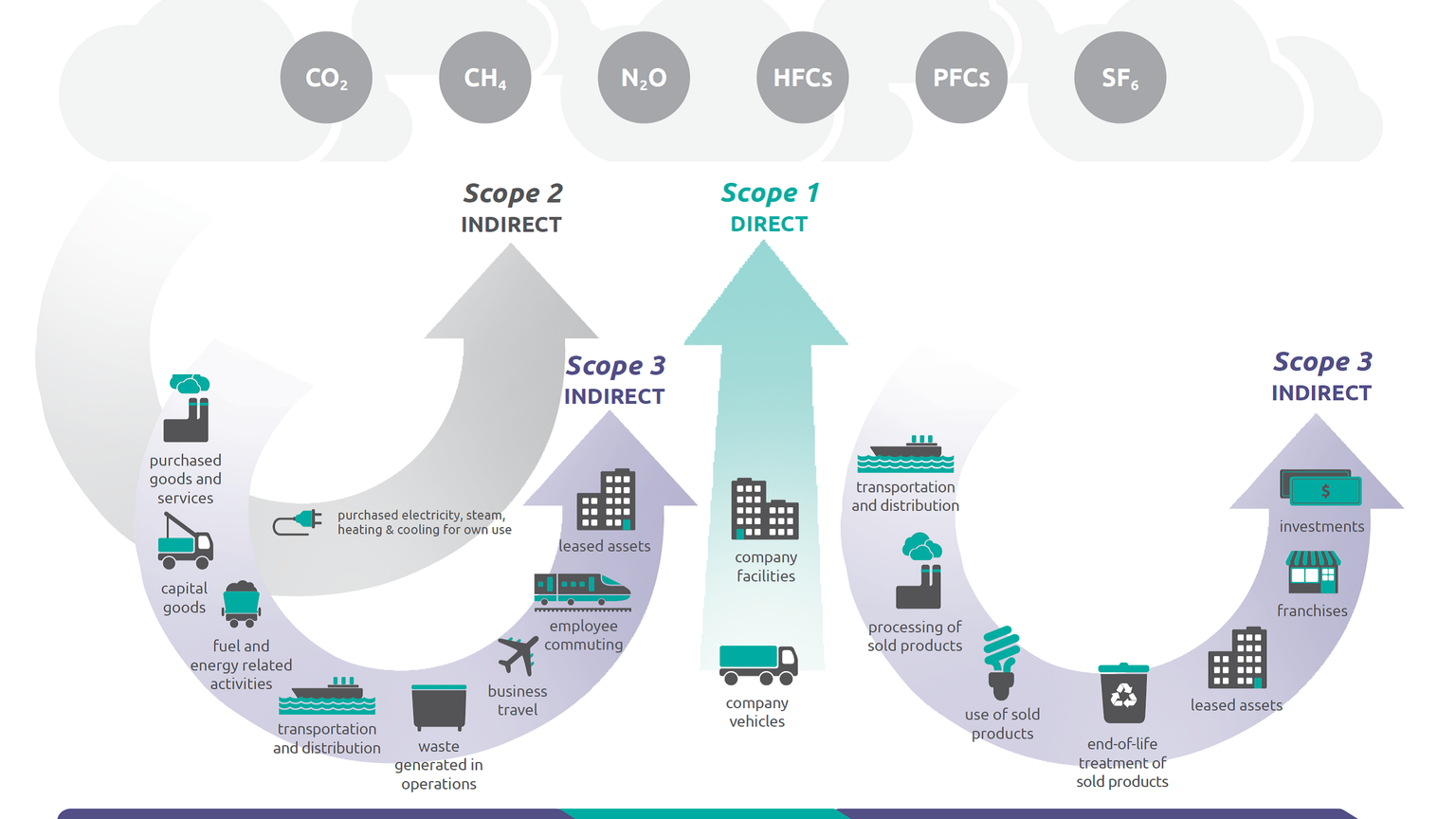
Scope 1, 2 and 3 emissions are the three categories of greenhouse gas (GHG) emissions defined by the GHG Protocol. Scope 1 covers direct emissions from sources a company owns or controls. Scope 2 covers emissions from purchased electricity, steam, heating and cooling. Scope 3 covers all other indirect emissions across the value chain, grouped into 15 categories.
Scope 1, 2 and 3 key facts
| Item | Detail |
|---|---|
| Standard | GHG Protocol Corporate Accounting and Reporting Standard |
| Scope 1 | Direct emissions from owned or controlled sources, such as boilers, generators and company vehicles |
| Scope 2 | Indirect emissions from purchased electricity, steam, heating and cooling |
| Scope 3 | All other indirect value-chain emissions, in 15 categories |
| NSRF assurance | Mandatory reasonable assurance on Scope 1 and 2, from 2028 for Group 1 |
What are Scope 1, 2 and 3 emissions?
Scope 1, 2 and 3 are the three categories the GHG Protocol uses to classify a company's greenhouse gas emissions. The GHG Protocol Corporate Standard is the most widely used method for GHG accounting, and IFRS S2 requires companies to measure emissions in line with it.
- Scope 1 emissions are direct emissions from sources the company owns or controls. Examples are fuel burned in boilers, generators and company vehicles, emissions from industrial processes, and refrigerant leaks.
- Scope 2 emissions are indirect emissions from the generation of electricity, steam, heating or cooling that the company buys. For most Malaysian companies, Scope 2 is mainly grid electricity from TNB, SESB or Sarawak Energy.
- Scope 3 emissions are all other indirect emissions in the value chain, both upstream and downstream. They include purchased goods, transport, business travel, employee commuting, waste and the use of sold products.
The split avoids double counting within a company's inventory. One company's Scope 1 emissions can be another company's Scope 3 emissions: a supplier's fuel use, for example, appears in its customer's Scope 3.
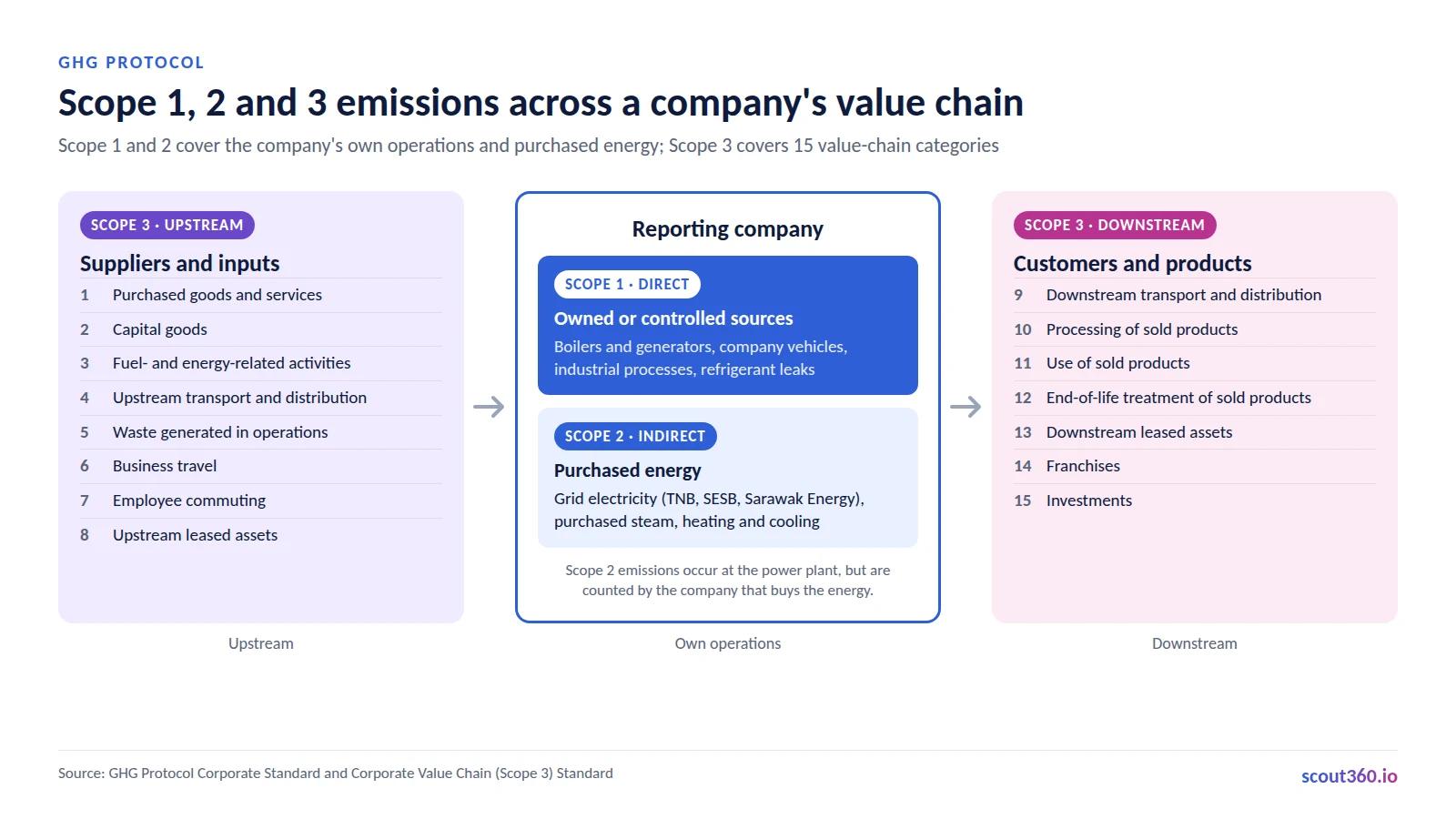
What are examples of Scope 1, 2 and 3 emissions for a Malaysian manufacturer?
For a typical Malaysian manufacturer, Scope 1 comes from fuel and refrigerants on site, Scope 2 from TNB electricity, and Scope 3 from suppliers, logistics and products.
| Scope | Typical sources for a manufacturer | Common data sources |
|---|---|---|
| Scope 1 | Diesel generators, natural gas boilers, forklifts, company cars and lorries, refrigerant top-ups, process emissions | Fuel invoices, fuel cards, gas bills, maintenance logs |
| Scope 2 | Purchased grid electricity; purchased steam or chilled water | TNB, SESB or Sarawak Energy bills; supplier invoices |
| Scope 3 | Raw materials and packaging, inbound and outbound freight, business travel, employee commuting, waste, use and disposal of sold products | Purchase records, logistics data, travel bookings, staff surveys, waste manifests |
In many manufacturing businesses, Scope 3 is the largest share of the footprint, driven mainly by purchased materials.
How do you calculate Scope 1 and Scope 2 emissions?
Scope 1 and Scope 2 emissions are usually calculated by multiplying activity data by an emission factor.
Emissions (tCO2e) = Activity data × Emission factor
- Activity data is the quantity of fuel burned, electricity bought or refrigerant lost, taken from invoices, bills and meter readings.
- Emission factor converts that quantity into tonnes of carbon dioxide equivalent (tCO2e). For fuels, use recognised factors such as the IPCC Guidelines. For refrigerants, apply the global warming potential (GWP) of the gas.
Worked example: Scope 2 from a TNB electricity bill
A factory in Peninsular Malaysia used 500,000 kWh of TNB electricity in 2024.
Add up the kWh from the 12 monthly bills: 500,000 kWh.
Convert to MWh: 500,000 kWh ÷ 1,000 = 500 MWh.
Apply the grid emission factor for Peninsular Malaysia in 2024: 0.740 tCO2e per MWh.
Calculate: 500 MWh × 0.740 = 370 tCO2e of Scope 2 emissions.
The same factory in Sarawak would use 0.199 tCO2e per MWh, giving about 100 tCO2e. This is why facilities in different regions must use their own regional factor.
Location-based and market-based Scope 2
The GHG Protocol recognises two Scope 2 methods. The location-based method uses the average grid emission factor, as in the example above. The market-based method reflects electricity a company has contracted for, such as renewable energy certificates (RECs) or green electricity tariffs. IFRS S2 requires location-based Scope 2, plus information on any contractual instruments.
The Energy Commission notes that its grid emission factor includes generators that may produce RECs. It therefore may not reflect the GHG intensity of electricity left unclaimed by RECs or other contractual instruments (Energy Commission, 2026).
What are the 15 Scope 3 categories?
The GHG Protocol Corporate Value Chain (Scope 3) Standard groups Scope 3 emissions into 15 categories: 8 upstream and 7 downstream (GHG Protocol).
| No. | Category | Direction | Example for a Malaysian manufacturer |
|---|---|---|---|
| 1 | Purchased goods and services | Upstream | Resin, steel, chemicals, packaging |
| 2 | Capital goods | Upstream | New machinery and buildings |
| 3 | Fuel- and energy-related activities | Upstream | Extraction and transmission losses of fuel and electricity |
| 4 | Upstream transportation and distribution | Upstream | Inbound freight paid for by the company |
| 5 | Waste generated in operations | Upstream | Scheduled waste and general waste disposal |
| 6 | Business travel | Upstream | Flights, hotels, e-hailing |
| 7 | Employee commuting | Upstream | Staff travel between home and work |
| 8 | Upstream leased assets | Upstream | Leased warehouses not in Scope 1 and 2 |
| 9 | Downstream transportation and distribution | Downstream | Outbound delivery paid for by customers |
| 10 | Processing of sold products | Downstream | Customers processing intermediate products |
| 11 | Use of sold products | Downstream | Energy used by appliances the company sells |
| 12 | End-of-life treatment of sold products | Downstream | Disposal of products and packaging |
| 13 | Downstream leased assets | Downstream | Property leased out to tenants |
| 14 | Franchises | Downstream | Franchisee operations |
| 15 | Investments | Downstream | Financed emissions, mainly for banks and investors |
Not every category applies to every company. For most manufacturers, categories 1, 4, 9 and 12 tend to matter most, with 11 significant for makers of energy-using products.
Which scopes must Malaysian companies report?
Under the NSRF, companies must report Scope 1 and Scope 2 emissions from their first reporting year. Scope 3 emissions become required once each group's transition relief ends.
| Requirement | Scope 1 and 2 | Scope 3 |
|---|---|---|
| NSRF (IFRS S2), during transition relief | Required | Not required |
| NSRF (IFRS S2), full adoption | Required | Required for all relevant categories: from 2027 for Group 1, 2028 for Group 2 and 2030 for Group 3 |
| Mandatory reasonable assurance | From 2028 (Group 1), 2029 (Group 2), 2030 (Group 3) | Not yet required |
Scope 3 dates are from the ACSR's NSRF summary; mandatory assurance dates are from the SC's media release of 17 September 2026.
SMEs are generally not required to report directly. Many are asked for Scope 1 and 2 data by customers, because a supplier's emissions form part of the customer's Scope 3.
What data do you need for a GHG inventory?
A first GHG inventory needs clear organisational and operational boundaries, 12 months of activity data, documented emission factors and a clearly described methodology.
Organisational boundary. Decide which entities and facilities are included, using the equity share, financial control or operational control approach. Apply the same approach every year.
Operational boundary. Identify the emission sources within the organisational boundary and classify each as Scope 1, 2 or 3. State which Scope 3 categories are included, and explain any exclusions.
Activity data. Collect fuel, electricity, refrigerant and other data for the full reporting year, with invoices or meter readings as evidence.
Emission factors. Record each factor, its source, its year and its units. Use the regional grid emission factor for each site, and state the global warming potential (GWP) values applied.
Methodology. Describe clearly how emissions are calculated: the standard followed, the boundaries, the data and emission factors used, and any estimates, assumptions or exclusions. IFRS S2 requires companies to disclose the measurement approach, inputs and assumptions behind their GHG emissions. A clear methodology is also the starting point for any assurance engagement.
Calculations and review. Keep the workings in one place, with a named preparer and reviewer.
What are common mistakes in a first GHG inventory?
Most errors in first-time inventories come from gaps in the boundary and the evidence, not from the arithmetic.
- Missing sources. Standby generators, refrigerant top-ups and company vehicles are often left out of Scope 1.
- Wrong grid factor. Applying the Peninsular factor to Sabah or Sarawak sites, or using an outdated year.
- Unit errors. Mixing kWh and MWh, or litres and kilograms of fuel.
- Incomplete year. Missing months of bills, or estimates that are not disclosed.
- No evidence trail. Figures that cannot be traced back to invoices or meter readings. This matters more as mandatory reasonable assurance approaches.
- Inconsistent boundary. A boundary that differs from the one used in the financial statements, without explanation.
Frequently asked questions
What is the difference between Scope 1, 2 and 3 emissions? Scope 1 is direct emissions from sources a company owns or controls. Scope 2 is indirect emissions from purchased electricity, steam, heating and cooling. Scope 3 is all other indirect emissions in the value chain.
Is electricity Scope 1 or Scope 2? Purchased grid electricity is Scope 2. Electricity a company generates itself from diesel or gas is Scope 1, because the fuel is burned on site.
What is Malaysia's grid emission factor? The Energy Commission's provisional 2024 grid emission factors are 0.740 tCO2e per MWh for Peninsular Malaysia, 0.539 for Sabah and 0.199 for Sarawak.
How do I calculate Scope 2 emissions from my TNB bill? Add up the kWh on 12 months of bills, convert to MWh, and multiply by the grid emission factor for that year and region. For example, 500 MWh × 0.740 = 370 tCO2e for a Peninsular site in 2024.
Are company cars Scope 1 or Scope 3? Vehicles the company owns or controls are Scope 1. Employees' own cars used for commuting are Scope 3 (category 7), and for work trips, Scope 3 (category 6).
Are solar panels and renewable energy certificates counted in Scope 2? On-site solar reduces the grid electricity bought, which lowers Scope 2. Renewable energy certificates affect only market-based Scope 2; IFRS S2 still requires location-based Scope 2.
Do Malaysian listed companies have to report Scope 3 emissions? Yes, once transition relief ends. Under the NSRF, Scope 3 is required from 2027 for Group 1, 2028 for Group 2 and 2030 for Group 3.
Do SMEs need to calculate Scope 1, 2 and 3 emissions? Most SMEs are not legally required to. However, many are asked for Scope 1 and 2 data by customers who report under the NSRF.
Which standard should Malaysian companies use for GHG accounting? IFRS S2 requires the GHG Protocol Corporate Standard, so companies reporting under the NSRF should use it. The GHG Protocol Scope 3 Standard covers the 15 value-chain categories.
Do Scope 1 and 2 emissions need assurance in Malaysia? Yes, in future. Mandatory reasonable assurance on Scope 1 and 2 starts in 2028 for Group 1, 2029 for Group 2 and 2030 for Group 3, under ISSA 5000.
Related guides
How Scout360 can help
Scout360 supports companies building their GHG inventories and climate disclosures in three ways, depending on how much support they need.
| Support | Suited to | What it covers |
|---|---|---|
| Full implementation support | Companies building their first GHG inventory or disclosure | Organisational and operational boundaries, Scope 1, 2 and 3 calculation, methodology documentation, GHG disclosures under IFRS S2 |
| Targeted technical support | Companies with an existing inventory or reporting partner | Inventory review, Scope 3 screening, emission factor selection, assurance readiness |
| Capacity building | Companies building in-house GHG accounting capability | GHG accounting training, data collection templates, technical review |
For companies that need it, Scout360 also offers a digital platform that simplifies data collection, calculation, review, evidence management and assurance preparation.
Sources
- Energy Commission (Suruhanjaya Tenaga): Grid Emission Factor (GEF) in Malaysia, 2022-2024, provisional, February 2026 (PDF)
- GHG Protocol: Corporate Value Chain (Scope 3) Standard
- Securities Commission Malaysia: ACSR's mandatory sustainability assurance requirement to take effect in 2028, 17 September 2026
- ACSR: NSRF summary, applicable entities and transition reliefs (PDF)