

Malaysian SMEs are being asked for ESG data because their customers now have to report on their own value chains. Listed companies reporting under the National Sustainability Reporting Framework (NSRF) must eventually disclose Scope 3 emissions, which include their suppliers' emissions. EU importers need emissions data under the Carbon Border Adjustment Mechanism (CBAM), and banks increasingly assess borrowers' climate risks.
Supplier ESG data key facts
| Item | Detail |
|---|---|
| Main reason | A supplier's emissions form part of its customer's Scope 3 emissions |
| Are most SMEs required to report under the NSRF? | No, but many are asked for data by customers who are |
| When my publicly listed customers need Scope 3 | Under the NSRF, from 2027 (Group 1), 2028 (Group 2) and 2030 (Group 3) |
| EU CBAM | Definitive regime since 1 January 2026, covering cement, iron and steel, aluminium, fertilisers, electricity and hydrogen |
| SME disclosure guide | Simplified ESG Disclosure Guide (SEDG) by Capital Markets Malaysia, free; Version 2 has 38 disclosures |
| Free SME calculator | Capital Markets Malaysia GHG emissions calculator for Scope 1 and 2, launched July 2025 |
| Most common first request | Scope 1 and 2 emissions, energy use and basic ESG policies |
| Proposed rules for non-listed companies | SSM consultation (April 2026): comply-or-explain reporting phased by size from 2028; not yet law |
Why are customers asking SMEs for ESG data?
Customers ask SMEs for ESG data because their own reporting, trade and financing now depend on what happens in their supply chains. Four pressures drive most requests.
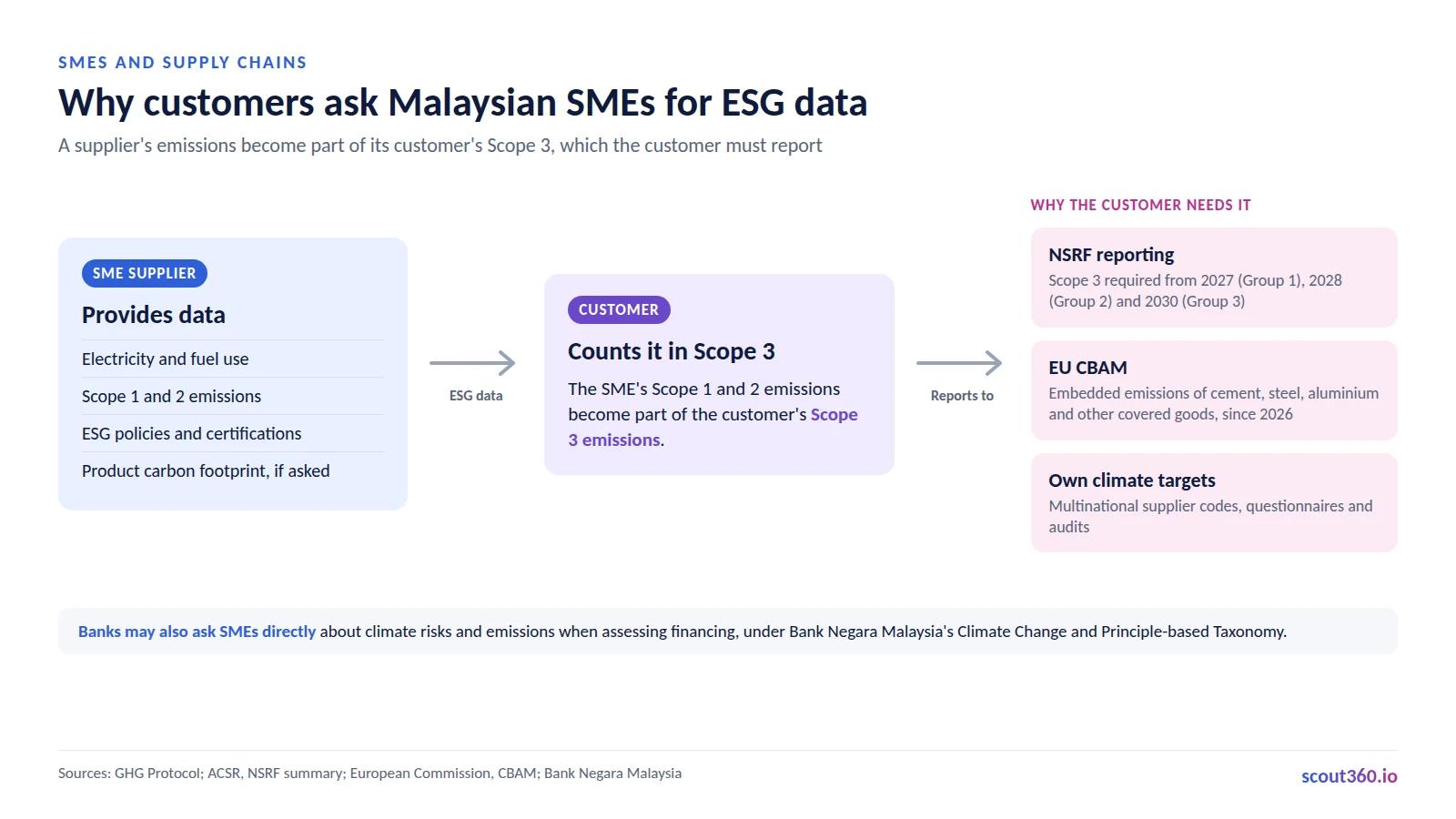
Value-chain emissions reporting. Under the GHG Protocol, a supplier's Scope 1 and 2 emissions form part of its customer's Scope 3 emissions. Listed companies reporting under the NSRF must disclose Scope 3 once their transition relief ends: from 2027 for Group 1, 2028 for Group 2 and 2030 for Group 3. To report accurately, they need data from their suppliers.
Export requirements. The EU's Carbon Border Adjustment Mechanism (CBAM) has applied in its definitive regime since 1 January 2026. EU importers of cement, iron and steel, aluminium, fertilisers, electricity and hydrogen must report the embedded emissions of those goods and surrender CBAM certificates (European Commission). Malaysian producers in these sectors are asked for emissions data on what they ship.
Multinational supplier programmes. Many multinational customers have their own climate targets and supplier codes. They screen suppliers through ESG questionnaires, platforms or audits, and may favour suppliers that respond well.
Bank financing. Banks in Malaysia classify financing using Bank Negara Malaysia's Climate Change and Principle-based Taxonomy (CCPT) and manage climate risk across their portfolios (Bank Negara Malaysia). As a result, SMEs are increasingly asked about climate risks and emissions when applying for financing.
For an SME, responding well can help keep existing contracts and win new ones. Not responding can mean being scored poorly, or replaced by a supplier that can provide the data.
So what exactly will customers ask for? The next section sets out the most common requests.
What ESG data do customers usually ask for?
Most supplier requests start with energy use and Scope 1 and 2 emissions, followed by basic policies on people and governance. More advanced customers then ask for targets, product-level footprints and evidence.
| Topic | Typical questions | Where the data usually comes from |
|---|---|---|
| Energy and emissions | Electricity and fuel used; Scope 1 and 2 emissions; any renewable energy | TNB bills, fuel invoices, generator logs |
| Climate targets | Do you have an emissions reduction target or plan? | Management decisions, board minutes |
| Product footprint | What is the carbon footprint of the product you supply? | Production data, material inputs, a product carbon footprint (PCF) study |
| Water and waste | Water use; scheduled waste and recycling | Water bills, waste manifests, contractor records |
| Labour and human rights | Policies on working hours, wages, foreign workers and recruitment fees | HR records, policies, audit reports |
| Health and safety | Injury rates and safety management | Incident records, DOSH reports |
| Governance and ethics | Anti-bribery, whistleblowing and supplier codes of conduct | Policies, training records |
| Certifications | ISO 14001, ISO 45001, ISO 50001 or similar | Certificates |
Customers often ask for evidence as well as answers, such as a policy document, a certificate or a calculation summary.
Most of this data already exists in an SME's bills, invoices and HR records. The steps below show how to pull it together.
How should an SME respond to a customer's ESG data request?
An SME can respond credibly with limited time and budget by starting with the data it already has, and building from there.
Clarify what the customer needs. Ask which questions are mandatory, the reporting period, the deadline and the format, whether a questionnaire, a platform or SEDG disclosures.
Appoint one owner. Give one person responsibility for ESG data, supported by finance, operations and HR.
Collect energy and fuel data. Gather 12 months of electricity bills, fuel invoices and generator logs. This covers most first requests.
Calculate Scope 1 and 2 emissions. Use a recognised method, such as the GHG Protocol, or the free Capital Markets Malaysia calculator. Record the emission factors and assumptions used.
Put basic policies in writing. Short, signed policies on environment, health and safety, labour practices and anti-bribery answer many governance and social questions.
Use SEDG as your base. Prepare your disclosures against SEDG at the Basic level, then reuse them for each customer instead of starting from scratch.
Keep the evidence together. File bills, calculations and policies in one place, so each answer can be supported if the customer asks.
Plan the next step. Once Scope 1 and 2 are in place, consider an emissions reduction plan or product carbon footprints for key products, depending on what customers ask for next.
Two free tools make steps 4 and 6 easier: the Simplified ESG Disclosure Guide (SEDG) and the Capital Markets Malaysia carbon calculator.
What is the Simplified ESG Disclosure Guide (SEDG)?
The Simplified ESG Disclosure Guide (SEDG) is a free ESG disclosure framework for SMEs in supply chains, issued by Capital Markets Malaysia, an affiliate of the Securities Commission Malaysia. It gives SMEs a standard set of ESG disclosures that customers can recognise, instead of a different questionnaire for every buyer.
- Launched: October 2023. Version 2, released in 2025, adds three disclosures, bringing the total to 38.
- Scope: 15 ESG topics across environment, social and governance.
- Levels: Basic, Intermediate and Advanced, so an SME can start small and build up.
- Extras: Sector guides for agriculture, construction, energy, manufacturing, and transport and logistics.
- Cost: Free, in English, Bahasa Melayu and Simplified Chinese.
Source: SEDG website
Is there a free carbon calculator for SMEs?
Yes. In July 2025, Capital Markets Malaysia launched a free GHG emissions calculator alongside SEDG Version 2. It calculates Scope 1 and Scope 2 emissions using the GHG Protocol, with pre-filled emission factors for common Malaysian fuels and Energy Commission grid electricity data (Eco-Business, July 2025). It does not cover Scope 3.
Even with the right tools, a few common mistakes can undermine an SME's answers.
What are common mistakes when answering supplier ESG questionnaires?
Most problems come from answers that cannot be supported, rather than from missing data.
- Guessing figures. Estimates without a method are hard to defend. Where data is estimated, say so and explain how.
- Claiming policies that do not exist. Answer "in progress" with a date, rather than "yes".
- Inconsistent answers. Different customers receiving different figures for the same year undermines trust.
- Ignoring the reporting period. Data should cover the period the customer asks for, usually a full calendar or financial year.
- Unit errors. Mixing kWh and MWh, or litres and kilograms of fuel.
- No named contact. Customers often follow up, so give a named person who can answer questions.
Do SMEs have to report under the NSRF?
Not yet. Most SMEs do not have to report under the NSRF today, but proposed changes to the Companies Act 2016 could bring many non-listed companies, including larger SMEs, into sustainability reporting from 2028.
The NSRF currently applies to companies listed on Bursa Malaysia and to non-listed companies with annual revenue of RM2 billion or more. Smaller companies are affected indirectly, through data requests from customers who report.
What has SSM proposed for non-listed companies?
On 30 April 2026, the Companies Commission of Malaysia (SSM) published a public consultation on amending the Companies Act 2016 to introduce "comply or explain" sustainability reporting for non-listed companies. The consultative document was revised on 22 May 2026, the consultation closed on 16 June 2026, and the proposals are not yet law (SSM).
The proposals set out four size tiers, based on annual revenue or number of employees, and three phases that build up towards IFRS S2.
| Tier | Revenue or employees | Phase 1: Scope 1 and 2 GHG emissions | Phase 2: governance, material risks and opportunities, selected ESG indicators | Phase 3: IFRS S2 |
|---|---|---|---|---|
| Tier 1 | RM1 billion to RM2 billion, or 500 or more employees | 2028 | 2029 | 2032 |
| Tier 2 | RM100 million to RM1 billion, or 250 to 499 employees | 2030 | 2031 | Not proposed |
| Tier 3 | RM15 million to RM100 million, or 100 to 249 employees | 2032 | 2033 | Not proposed |
| Tier 4 | Below RM15 million and fewer than 100 employees | Voluntary | Voluntary | Voluntary |
The proposals also phase in internal and limited assurance for each tier, with reasonable assurance deferred for now. Directors who fail to comply could face a fine of up to RM20,000.
What this means for SMEs: SMEs do not have to follow IFRS sustainability standards yet. Under the proposals as consulted, larger SMEs would mostly fall into Tier 3, starting with Scope 1 and 2 emissions from 2032, while only Tier 1 companies would move to full IFRS S2. Building Scope 1 and 2 data now, as set out in the steps above, prepares an SME for both customer requests and these proposed rules.
Frequently asked questions
Why is my customer asking for ESG data? Your customer needs to report on its value chain, comply with export rules such as the EU CBAM, or meet its own climate targets. Your emissions form part of its Scope 3 emissions.
Do SMEs have to report under the NSRF? Not yet. The NSRF applies to listed companies and non-listed companies with annual revenue of RM2 billion or more. However, SSM has consulted on phased, comply-or-explain sustainability reporting for smaller non-listed companies from 2028.
Will SMEs have to follow IFRS S2? Not under current rules. SSM's April 2026 proposals would phase in climate disclosures by company size, with full IFRS S2 proposed only for the largest non-listed companies, from 2032. The proposals are not yet law.
What is the SEDG? The Simplified ESG Disclosure Guide (SEDG) is a free ESG disclosure framework for SMEs in supply chains, issued by Capital Markets Malaysia. Version 2 has 38 disclosures across 15 topics.
What ESG data do customers ask SMEs for first? Most customers start with electricity and fuel use, Scope 1 and 2 emissions, and basic policies on health and safety, labour and anti-bribery.
How can an SME calculate its carbon emissions for free? Capital Markets Malaysia offers a free GHG emissions calculator for Scope 1 and 2, with Malaysian fuel and grid emission factors built in.
Does an SME need to report Scope 3 emissions? Usually not at first. Most customers ask suppliers for Scope 1 and 2. Some may later ask for product carbon footprints or selected Scope 3 categories.
What happens if an SME does not respond? The customer may score the supplier poorly, use estimates instead, or prefer suppliers that provide data. Over time, this can affect contracts.
Does CBAM affect Malaysian SMEs? Yes, if they produce or supply cement, iron and steel, aluminium, fertilisers, electricity or hydrogen sold to the EU. EU importers need embedded emissions data for these goods.
Can an SME reuse the same ESG answers for different customers? Yes. Preparing disclosures against SEDG, with supporting evidence, lets an SME reuse the same core data for most questionnaires.
How long does it take an SME to prepare basic ESG data? With 12 months of bills and invoices available, a basic Scope 1 and 2 calculation and key policies can usually be prepared within a few weeks.
How Scout360 can help
Scout360 supports SMEs responding to customer ESG requests, and larger companies collecting data from their suppliers, in three ways.
| Support | Suited to | What it covers |
|---|---|---|
| Full implementation support | SMEs that need ESG data and disclosures prepared from start to finish | Scope 1 and 2 calculation, SEDG-based disclosures, ESG policies, customer questionnaire responses |
| Targeted technical support | SMEs with some data, or companies running supplier programmes | Data gap review, materiality assessment, supplier engagement and data collection design, CBAM data readiness, product carbon footprints (PCF), LCA and EPD preparation |
| Capacity building | Companies building in-house ESG capability, including supplier training | ESG, carbon accounting and PCF training for SMEs, data collection templates, technical review |
For companies that need it, Scout360 also offers a digital platform that simplifies data collection, calculation, review, evidence management and assurance preparation.
Sources
- Capital Markets Malaysia: Simplified ESG Disclosure Guide (SEDG)
- Eco-Business: Capital Markets Malaysia expands SEDG with a GHG emission calculator for SMEs, July 2025
- European Commission: Carbon Border Adjustment Mechanism
- Bank Negara Malaysia: Climate change and the Climate Change and Principle-based Taxonomy
- ACSR: NSRF summary, applicable entities and transition reliefs (PDF)
- Allen & Gledhill: SSM conducts public consultation on proposed sustainability reporting amendments to Companies Act 2016, 2026
- SSM: Consultative Document on the Proposed Amendments to the Companies Act 2016 on Sustainability Reporting, revised 22 May 2026 (PDF)