

Popular Workshop
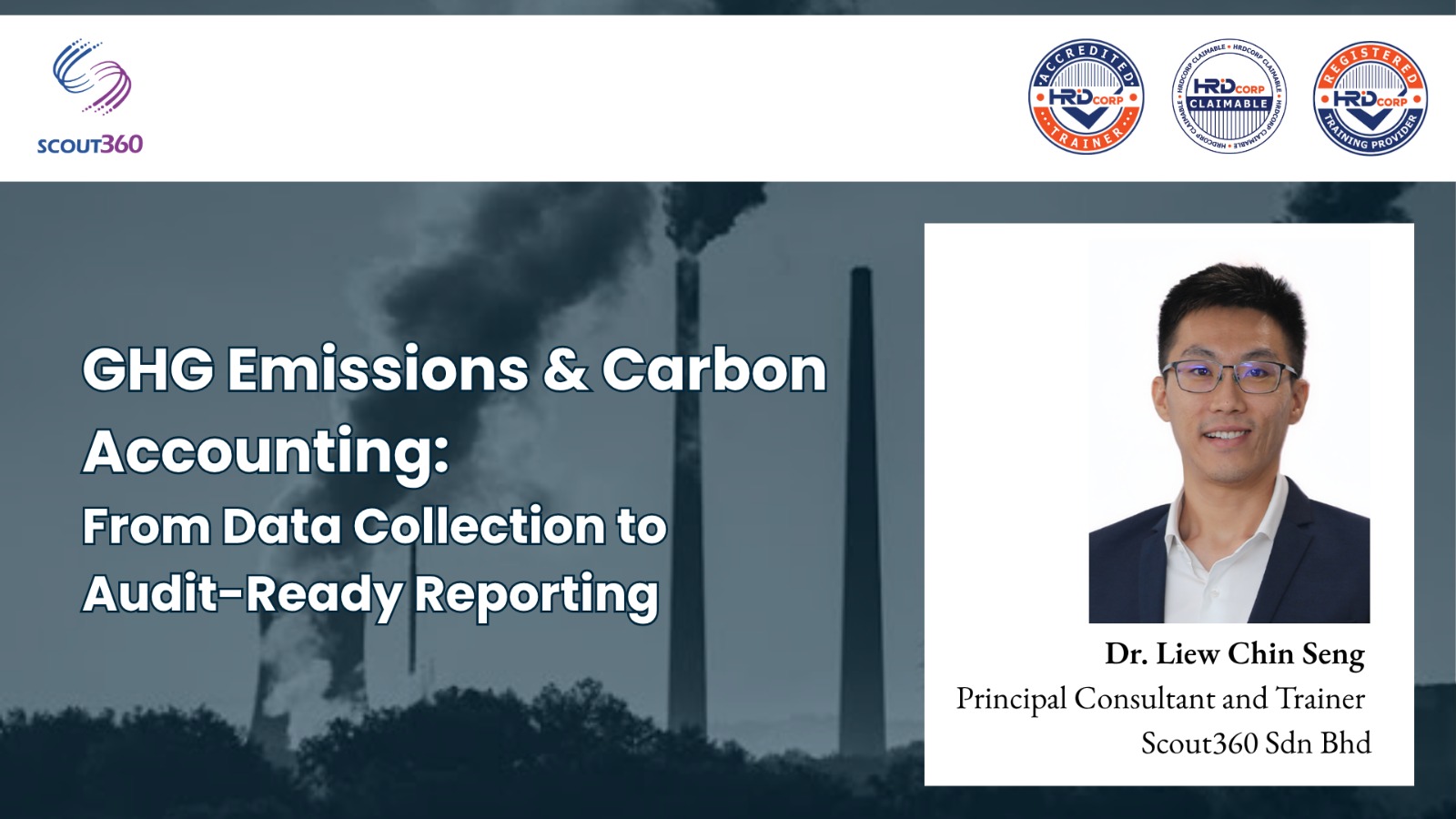
GHG Emissions and Carbon Accounting: From Data Collection to Audit-Ready Reporting
Two days following a carbon footprint from activity data through to disclosure, closing with assurance requirements and a mock GHG audit.
HRD Corp claimable. Tell us when you enquire, so the grant application can be submitted before the programme begins.
- Level
- Suitable for beginners and intermediate
- Trainer
- Dr. Liew Chin Seng
- Duration
- 2 days / 14 hours
- Mode
- Physical workshop
- Language
- English
Overview
About this workshop.
Carbon numbers are increasingly read by people who did not produce them: verifiers, auditors, customers, regulators and investors. That changes what a GHG inventory has to be. Arriving at a total is no longer enough. The organisation has to show the boundary it used, the activity data behind each figure, the emission factor applied and the record that supports it.
This two-day workshop follows a footprint from data collection through to disclosure. It covers Scope 1 and Scope 2 calculation, the 15 Scope 3 categories with mapping, screening and prioritisation, activity-based and spend-based methodologies, and the data ownership, controls and evidence that make an inventory reviewable. It closes with IFRS S2 GHG disclosure requirements, NSRF assurance expectations, ISO 14064-3 and ISSA 5000, and a mock GHG audit.
Participants leave able to define boundaries, calculate emissions using suitable data and factors, organise records so every number can be traced back to source, and anticipate what a verifier will ask for. Preparing an organisation's own inventory, and the independent verification of it, are separate engagements: this is the capability that comes first.
Programme outline
Eight sessions across two days.
Each session pairs the requirement with an exercise participants complete themselves.
- 1
Introduction to GHG Emissions and Carbon Accounting
- GHG and carbon accounting fundamentals
- Carbon-related risks and opportunities
- Key standards and regulatory trends
- Exercise: define reporting boundaries
- 2
Scope 1 and Scope 2 Emissions
- Scope 1 and Scope 2 sources
- Activity data and emission factors
- Calculation methods and references
- Exercise: calculate Scope 1 and Scope 2 emissions
- 3
Scope 3 Emissions
- Understanding the organisational value chain
- The 15 Scope 3 categories
- Industry-specific emission examples
- Exercise: map the value chain
- 4
Scope 3 Mapping, Screening and Calculation
- Mapping Scope 3 emission sources
- Screening relevant categories
- Prioritising significant emissions
- Scope 3 data and calculation requirements
- 5
Scope 3 Calculation Methodologies
- Activity-based calculation
- Spend-based calculation
- Data and emission-factor selection
- Choosing the appropriate methodology
- 6
Audit-Ready GHG Data Management
- Reliable data sources and collection
- Data ownership and internal controls
- Traceable records and evidence
- Materiality in GHG data management
- 7
Preparing Compliant GHG Disclosures
- IFRS S2 GHG disclosure requirements
- Clear and supportable reporting
- Common disclosure weaknesses
- Case study: review good disclosures
- 8
GHG Verification and Assurance Readiness
- NSRF assurance requirements
- ISO 14064-3 and ISSA 5000
- Assurance levels and materiality
- Exercise: mock GHG audit
Learning outcomes
What participants will be able to do.
- Define organisational boundaries and identify relevant Scope 1, Scope 2 and Scope 3 emission sources.
- Calculate GHG emissions using suitable activity data, emission factors and methodologies.
- Organise GHG data in a structured, traceable and assurance-ready manner.
- Explain key GHG disclosure and assurance requirements, including IFRS S2, NSRF, ISO 14064-3 and ISSA 5000.
What you receive
What participants take away.
- Gain practical knowledge and skills from experienced industry practitioners for immediate workplace application.
- Receive direct answers and guidance on your carbon accounting challenges.
- Access comprehensive training materials, including slides, templates and checklists.
- Earn a training certificate to strengthen your professional profile.
- Connect with other sustainability practitioners and learn from their experiences.
Your trainer
Who leads the room.

Dr. Liew Chin Seng
Principal Consultant and Trainer, Scout360 Sdn Bhd
Dr. Liew Chin Seng is the Principal Consultant of Scout360 Sdn Bhd, a sustainability technology company incubated and funded by PETRONAS Innovation Garage. He has advised listed companies and MSMEs on ESG reporting, carbon accounting and digital sustainability data management. A PhD holder in Sustainable Energy, Dr. Liew is also an ISO 14064 Greenhouse Gas Lead Verifier, Certified Net Zero Carbon Emission Leader and HRD Corp Accredited Trainer, bringing together industry experience, academic expertise and practical implementation insights.
Common questions
Frequently asked questions.
Yes. Scout360 Sdn Bhd is an HRD Corp registered training provider and the programme is led by an HRD Corp accredited trainer, so employers registered with HRD Corp can claim it against their levy. Tell us when you enquire that you intend to claim: the grant application has to be submitted and approved before the programme begins, so we need to know in advance in order to prepare and submit it for you.
Sustainability, HSE, engineering, facilities, procurement and finance staff who collect, calculate or consolidate emissions data, and the managers who sign those numbers off. It also suits teams preparing for a first GHG verification or responding to customer carbon requests.
Yes. Participants define boundaries, calculate Scope 1 and Scope 2 emissions, map a value chain, work through activity-based and spend-based Scope 3 methods and take part in a mock GHG audit. A general sense of your own utility, fuel and procurement records makes the exercises more useful, though no organisational data is required.
Three of the eight sessions. Scope 3 is treated as its own body of work: understanding the value chain and the 15 categories, mapping and screening sources to decide what is relevant, and then choosing between activity-based and spend-based calculation for the categories that matter.
No. The workshop prepares an organisation to be verified. It explains NSRF assurance requirements, ISO 14064-3 and ISSA 5000, assurance levels and materiality, and closes with a mock audit so participants see the questions a verifier asks. Independent verification is a separate engagement carried out by an accredited verification body, and Scout360 does not verify an inventory it has prepared.
Dates and venues are confirmed for each intake. Tell us roughly how many participants you expect and we will confirm the next available session, or arrange an in-house run for your organisation alone. In-house delivery follows the same programme and can be adapted to your sector, reporting maturity and participant responsibilities.
Other workshops
Programmes teams often pair with this one.
Every programme can also be built around one organisation. See how Scout360 approaches training and capacity building.
Bring this workshop to your team.
Tell us how many participants you expect, whether you are joining a scheduled session or running it in-house, and whether you intend to claim it under HRD Corp.